
Chile travel data
Chile eSIM Guide: Best Plans, Coverage & Hotspot Tips for Santiago, Atacama & Patagonia
Pick an eSIM that actually works where you’ll be: Entel for remote routes, Movistar/Claro for city speed, WOM for budget urban trips — plus hotspot realities for multi-device use.
Quick summary: Santiago and major coastal cities have strong 4G/5G. For San Pedro de Atacama and Patagonia choose Entel-backed plans. Many eSIMs allow tethering but expect fair-use throttles and device limits.
Performance
Network performance & where it matters
Entel typically offers the most consistent coverage across Atacama and southern Patagonia; prefer it for Ruta 5 stretches and Carretera Austral.
Movistar and Claro deliver strong 4G/5G in Santiago, Valparaíso and major airports (SCL, CJC, PUQ); good choice for streaming and video calls.
WOM is aggressive on price and expanding 4G in cities but has historically weaker coverage in very remote regions.
Expect long gaps of no signal. For multi-day treks use Entel where possible, offline maps, and a satellite backup for safety-critical trips.
Top routes & airports
Where coverage changes — airports, deserts and Patagonia
Santiago (SCL) is the best place to activate and test an eSIM — 4G/5G is reliable in the metro area. Valparaíso and Viña del Mar share good coastal coverage.
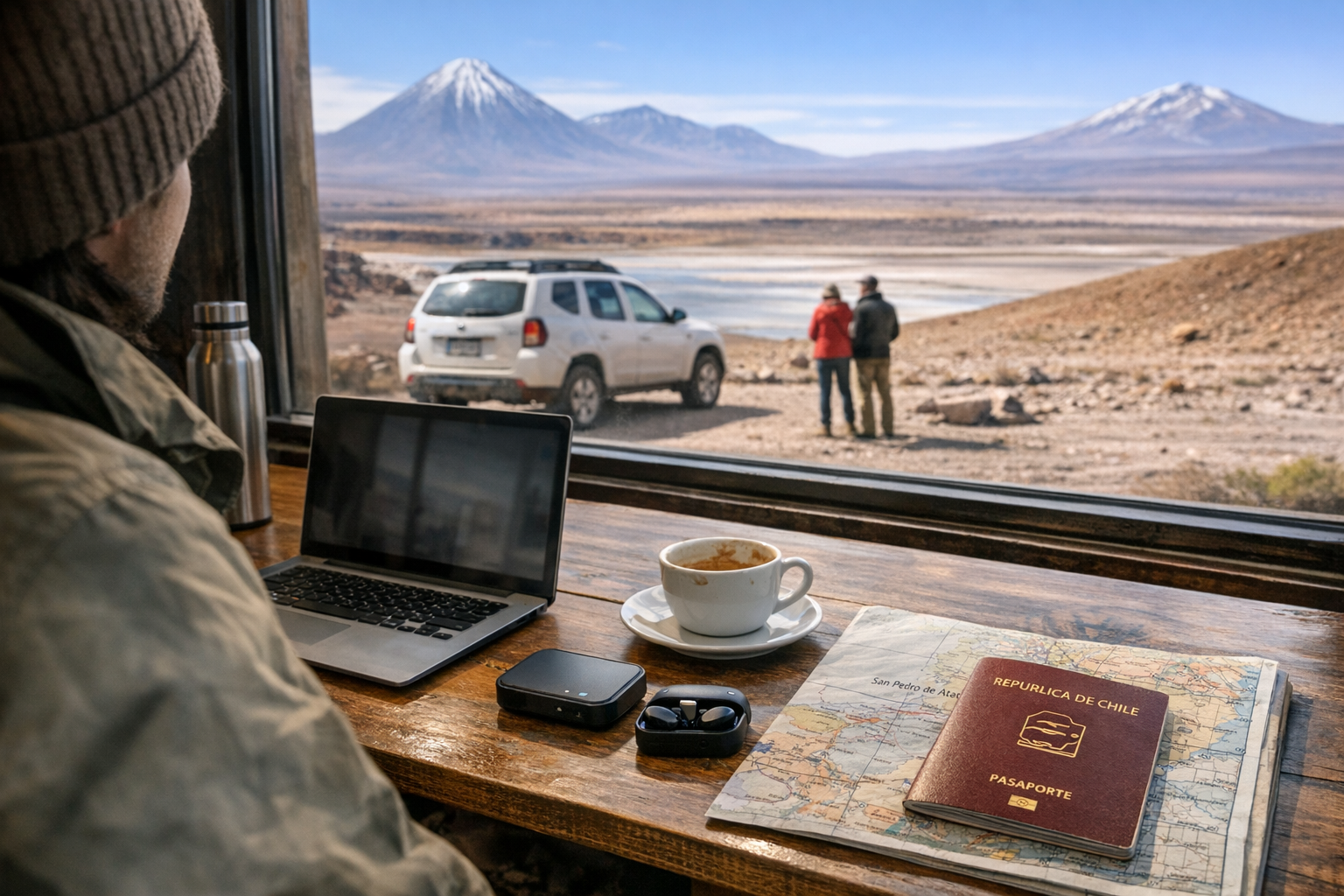
San Pedro de Atacama (near Calama, CJC) has patchy connectivity outside town limits; plan for offline navigation on high-altitude roads.
Patagonia (Puerto Natales, Torres del Paine, Punta Arenas PUQ) is sparsely covered — Entel performs best where any mobile signal exists; still expect dead zones.
SCL — arrival hub
Activate eSIM here for fastest provisioning and to run a quick coverage test before you head north or south.
Atacama caution
Outside San Pedro expect spotty service. Buy a larger data buffer and keep offline maps for desert routes.
Easter Island
Very limited operator presence; confirm coverage with your provider before booking.
Choosing a plan
Match plan type to trip style
Short city stays (3–7 days): choose small data bundles (3–5 GB) from Movistar/Claro/WOM for best price and 5G access in Santiago.
Active multi-city trips (7–14 days): pick 10–20 GB and prioritize Entel or Movistar for regional reach and hotspot allowance.
Long stays/digital nomads (30–90 days): use large or unlimited plans with renewable top-ups; check hotspot policy and remote top-up options.
Hotspot needs
If you need phone + laptop, pick plans that explicitly allow tethering and have larger data pools to avoid FUP throttles.
Cross-border travel
If you’ll visit Argentina or Bolivia, consider multi-country eSIMs but verify roaming routes and coverage near border passes.
Activation & troubleshooting
Practical setup tips and common fixes
Activate eSIM in a city (Santiago or Calama) where provisioning is faster. Test data, voice (if included) and tethering before leaving the hub.
Check your device model for eSIM support and whether your phone is carrier-locked. Remove old profiles when switching operators to avoid routing conflicts.
If an eSIM fails to connect on arrival: toggle airplane mode, restart device, confirm APN settings, and re-scan for carrier networks. If problems persist, reissue the eSIM via vendor app or support chat.
ID & activation
Some providers require ID at activation or for local number provisioning — have passport photo ready for local SIM pickup or KYC in apps.
Swapbacks
If moving to very remote zones, carry a local physical SIM (Entel preferred) as a fallback for spots where eSIM provisioning may fail.
Hotspot & tethering
Real-world tethering rules you’ll encounter
Many retail eSIM/data-only plans allow tethering but language varies — check vendor & operator terms. Commonly carriers apply fair‑use policies that can throttle hotspot traffic after a threshold.
Simultaneous device counts are often not explicitly guaranteed; in practice expect reliable tethering for 1–3 devices and possible slowdowns beyond that.
For road trips and multi-device work, prefer plans that explicitly state hotspot allowance and higher GB caps, or bring a dedicated portable router plus a local SIM as backup.
What to expect
Allowed tethering is common, but providers may throttle or restrict tethered speeds after FUP limits.
Multi-device travel
If you need stable laptop connectivity on the go, select higher-GB plans or Entel-backed packages for broader signal coverage.
Comparison
Operator at-a-glance
| Operator strengths | When to pick |
|---|---|
| Entel — best national coverage, strongest in remote north and south; good 4G/5G in cities | Choose Entel for road trips, Carretera Austral and Torres del Paine where other networks drop |
| Movistar — solid urban footprint and established roaming; good 4G/5G in Santiago and major regional centers | Pick Movistar for reliable city speed and when you need a balance of coverage and price |
| Claro — competitive city speeds and decent regional coverage; often bundled offers for travelers | Good choice for visitors centered on Santiago, Valparaíso or regional towns |
| WOM — aggressive prices, expanding 4G in cities but weaker remote reach | Best for budget-focused city stays; avoid as sole option for Patagonia/Atacama |
Pro tips
Practical tips before you buy
Activate and test your eSIM in Santiago (SCL) or Calama (CJC) where provisioning is fastest.
If visiting Easter Island or remote trails, confirm operator coverage for the exact location; consider a physical SIM backup or satellite device.
Read the hotspot/FUP wording: some plans cap tethering speed or deprioritize hotspot traffic during congestion.
For cross-border routing (Argentina/Bolivia), prefer multi-country eSIMs and verify roaming limits on border highways.
Remove old eSIM profiles before installing a new one, and keep a copy of the QR code or vendor app credentials until verification is complete.
Live picks
Quick pick — recommended plan types
Saily
Chile 1GB 7 days
Hidden caveat: Local number availability. Physical SIMs include a Chile number; some global/eSIM tourist packages may not provide a local number.
Saily
Chile 3GB 30 days
Hidden caveat: Local number availability. Physical SIMs include a Chile number; some global/eSIM tourist packages may not provide a local number.
Saily
Chile 5GB 30 days
Hidden caveat: Local number availability. Physical SIMs include a Chile number; some global/eSIM tourist packages may not provide a local number.
Saily
Chile 10GB 30 days
Hidden caveat: Local number availability. Physical SIMs include a Chile number; some global/eSIM tourist packages may not provide a local number.
Saily
Chile 20GB 30 days
Hidden caveat: Local number availability. Physical SIMs include a Chile number; some global/eSIM tourist packages may not provide a local number.
Explore more
Ready to choose?
Filter live offers for Entel-backed coverage if you’ll travel off-grid, or pick Movistar/Claro/WOM for budget city trips. Use the hotspot filter to avoid surprises.
Related guides
More Chile reading

Best eSIMs for Chile: Coverage, Hotspot Tips & Road‑Trip Guide (Santiago → Atacama → Patagonia)
A practical guide to choosing an eSIM for Chile — from Santiago 5G to Entel’s rural reach in Patagonia, hotspot rules, and a small set of recommended plans for different trips.
Open guide
Chile eSIM for Torres del Paine & Atacama: Coverage, Hotspot Rules and Best Operators (Entel, Movistar, WOM, Claro)
Which Chile eSIM should you buy for Santiago, San Pedro de Atacama or Torres del Paine? We compare Entel, Movistar, WOM and Claro for coverage, hotspot rules and real-world behavior.
Open guide