
France eSIMs & tethering
Best eSIMs for France (Paris, Provence, Riviera, Lyon): Coverage, Hotspot & Tethering Guide
Find the cleanest eSIM setup for Paris, the Riviera, Provence road trips and Alpine ski stays — with practical hotspot rules and real-world coverage notes.
Quick picks: Best for cities: local Orange/Bouygues eSIM or a France-specific travel eSIM routed on Orange. Best for road trips: Orange-backed plan or a Europe roaming plan with ample GB. Best for heavy tethering: paid ‘unlimited’ travel eSIMs with fair-use caveats and an Orange backup SIM.

Performance
Performance by terrain & operator
Orange typically has the most consistent rural and mountain coverage; France-language support and robust roaming rules make it a solid primary choice for road trips.
Bouygues and SFR perform strongly in cities and along major motorways; they’re good mid-range choices if price and urban throughput matter.
Free often offers cheaper bundles and 4G/5G in cities but has sparser rural and mountain footprint compared with Orange or Bouygues.
Expect gaps in higher elevations and ski lifts; coverage near ski towns is OK but remote slopes can drop to 3G or no signal.
Nice–Cannes–Saint-Tropez corridors are well served; coastal secondary roads and coves can have intermittent coverage.
Major MNO eSIMs allow tethering; for heavy uploads bring a backup SIM or multi‑SIM approach as performance varies by cell load.
Summary
Quick summary — which eSIM to pick
For most travelers: pick a France-specific eSIM routed on Orange or buy a local Orange/Bouygues/SFR eSIM at arrival. They give the best mix of urban coverage and rural reach.
If price is the priority: Europe-region eSIMs from Airalo or Nomad can be cheaper but may route on different networks and sometimes enforce hotspot limits.
If you need sustained tethering: unlimited travel eSIMs (Holafly, some Nomad offers) exist, but expect a fair-use policy and possible deprioritization in congested areas.
Best for city stays
Local Bouygues or SFR eSIM; or France plan on Airalo mapped to Orange for best metro speeds.
Best for road trips
Orange-backed plans or a larger GB Europe plan to avoid running out in rural stretches.
Best for tethering
Paid unlimited travel eSIMs but pack a power bank and a backup SIM — fair-use applies.
Networks & rules
French MNOs, MVNOs and EU roaming basics
Primary networks: Orange, SFR (Altice), Bouygues Telecom and Free Mobile. Operator coverage maps (operator sites) are the best source for location-level expectations.
MVNOs such as NRJ Mobile and La Poste Mobile exist but have limited eSIM availability and may not offer immediate provisioning — check each operator’s docs.
EU residents: domestic SIMs can use EU roaming allowances subject to operator fair-use policies — travel eSIMs sold as ‘Europe’ may still be limited per-country.
Coverage maps
Check Orange, SFR, Bouygues and Free network maps before long drives or ski trips.
MVNO caveat
MVNO eSIMs are convenient but often lack the full network access or eSIM easy-activation of MNOs.
Providers
How travel eSIMs compare to local operator eSIMs
Global travel eSIM vendors (Airalo, Nomad/SimOptions, Holafly, Truphone, Ubigi, GigSky) sell France-only or Europe-region plans. They vary on which MNO they route traffic through and on hotspot allowances.
Local Orange/SFR/Bouygues eSIMs generally give better performance and predictable hotspot behavior; travel eSIMs win on convenience and pre-trip activation.
Airalo / Nomad
Low-cost France/Europe plans; check vendor T&Cs for tethering and network routing.
Holafly / Truphone
Offer big or unlimited bundles; confirm fair-use thresholds and whether provider allows laptop tethering.
Local MNO eSIMs
Best raw coverage and predictable hotspot policies; may require passport and French-language signup in some cases.
Travel scenarios
Real itineraries & recommended plans
3-day Paris business trip: a 5–10 GB France plan routed on Orange or Bouygues is enough; prefer local eSIM or a France-specific travel eSIM that declares Orange network routing.
7-day Provence & Riviera road trip: choose 20–30 GB on an Orange-backed plan or a Europe plan with generous GB. Expect intermittent coverage on secondary coastal roads and rural hinterland.
5-day Chamonix ski trip: get 10–20 GB plus a backup SIM (Orange recommended) — uplink-heavy tasks (large uploads, cloud sync) may be slower in mountain valleys.
Paris business
5–10 GB, Orange or Bouygues, tethering allowed — disable heavy syncs during calls.
Provence road trip
20–30 GB on Orange-backed plan; expect 3G/edge in some rural spots.
Chamonix ski week
10–20 GB; carry backup SIM and power bank for long days on lifts and routes.
Activation
Installation, APN and quick troubleshooting
Most eSIM vendors provide a QR code and auto-APN setup. Install before you travel if your device supports eSIM profiles and airplane mode activation.
Common issues: eSIM not installing (device profile limit), hotspot not working (APN or vendor policy), slow data (deprioritization or poor cell).
If hotspot fails: check APN settings, confirm vendor allows tethering in T&Cs, restart device, or swap to a local MNO eSIM as a fallback.
APN fallback
If auto-APN fails, ask the vendor for manual APN settings or use operator APN (found on operator support pages).
Profile limits
Some phones limit eSIM profiles; delete unused profiles or activate while connected to Wi‑Fi during install.
Final
Last checks before you buy
Always read the tethering/fair‑use policy of the eSIM product page. Sellers differ in whether they explicitly allow laptop tethering or will throttle it.
Carry a portable charger and consider a compact secondary SIM from Orange for long rural legs or important meetings.
If you rely on uploads or stable upstream for work, prefer operator eSIMs mapped to Orange/Bouygues and test the hotspot in your first hour on site.
Testing
Test speeds and hotspot behavior on arrival; many vendors offer a short refund window if the eSIM fails to activate.
Language & support
Check if vendor support is in English — local operators often provide French-first support but have English resources.
Comparison
Provider quick comparison
| Provider | Quick notes |
|---|---|
| Airalo | Low-cost France/Europe bundles; convenient pre-trip install; hotspot allowed but check specific plan T&Cs. |
| Nomad (SimOptions) | Competitive Europe and France plans; some plans route on Orange; check hotspot/fair-use language. |
| Holafly | Big/unlimited bundles marketed for travel; fair‑use policies apply — good for heavy short-term tethering. |
| Truphone / Ubigi | Global eSIM providers with multi-country plans; useful for multi-country trips but check per-country routing. |
| Local Orange eSIM | Best national reach and predictable hotspot policy; ideal for rural drives and ski valleys. |
| Bouygues / SFR eSIMs | Strong urban performance and competitive pricing; good for city stays and TGV corridors. |
| Free Mobile | Cheapest urban plans often; watch for reduced rural/mountain coverage compared to Orange. |
Pro tips
Practical tips for hotspot success
Buy the eSIM that lists which French MNO network it uses — Orange for rural reliability.
Carry a small backup physical SIM from Orange or a multi‑SIM adapter for mission‑critical work.
Disable automatic cloud backups and large updates while tethering to conserve data and reduce stalls.
Test hotspot and VoIP on arrival; request a manual APN from vendor if tethering fails.
Keep a power bank — tethering can cut battery life quickly during long drives or full-day excursions.
If using an ‘unlimited’ travel eSIM, screenshot the fair-use policy and note support contact for disputes.
On trains (TGV), expect fast speeds but possible cell handover drops — download large files before departure.
For ski resorts: expect good coverage in towns, patchy signal on lifts and remote runs; plan uploads accordingly.
Live picks
Where to buy & next steps
Saily
France 1GB 7 days
Hidden caveat: French local numbers. Included with most prepaid and postpaid SIMs and eSIMs; in‑store registration may require ID.
Saily
France 3GB 30 days
Hidden caveat: French local numbers. Included with most prepaid and postpaid SIMs and eSIMs; in‑store registration may require ID.
Saily
France 5GB 30 days
Hidden caveat: French local numbers. Included with most prepaid and postpaid SIMs and eSIMs; in‑store registration may require ID.
Saily
France 10GB 30 days
Hidden caveat: French local numbers. Included with most prepaid and postpaid SIMs and eSIMs; in‑store registration may require ID.
Saily
France 20GB 30 days
Hidden caveat: French local numbers. Included with most prepaid and postpaid SIMs and eSIMs; in‑store registration may require ID.
Explore more
Buy recommended France eSIMs
Start with an Orange-backed France plan for road trips and rural reliability. For city-only stays, a France-specific Airalo or Nomad plan is often cheaper and convenient. If you need heavy tethering, consider a paid unlimited travel eSIM but keep a local backup SIM.
Related guides
More France reading

Best eSIM for France: Paris, Nice & TGV Travel — Complete Guide
A practical guide to choosing an eSIM for France—coverage tradeoffs (Orange vs Free), tethering rules, TGV behavior and activation steps for iPhone/Android.
Open guide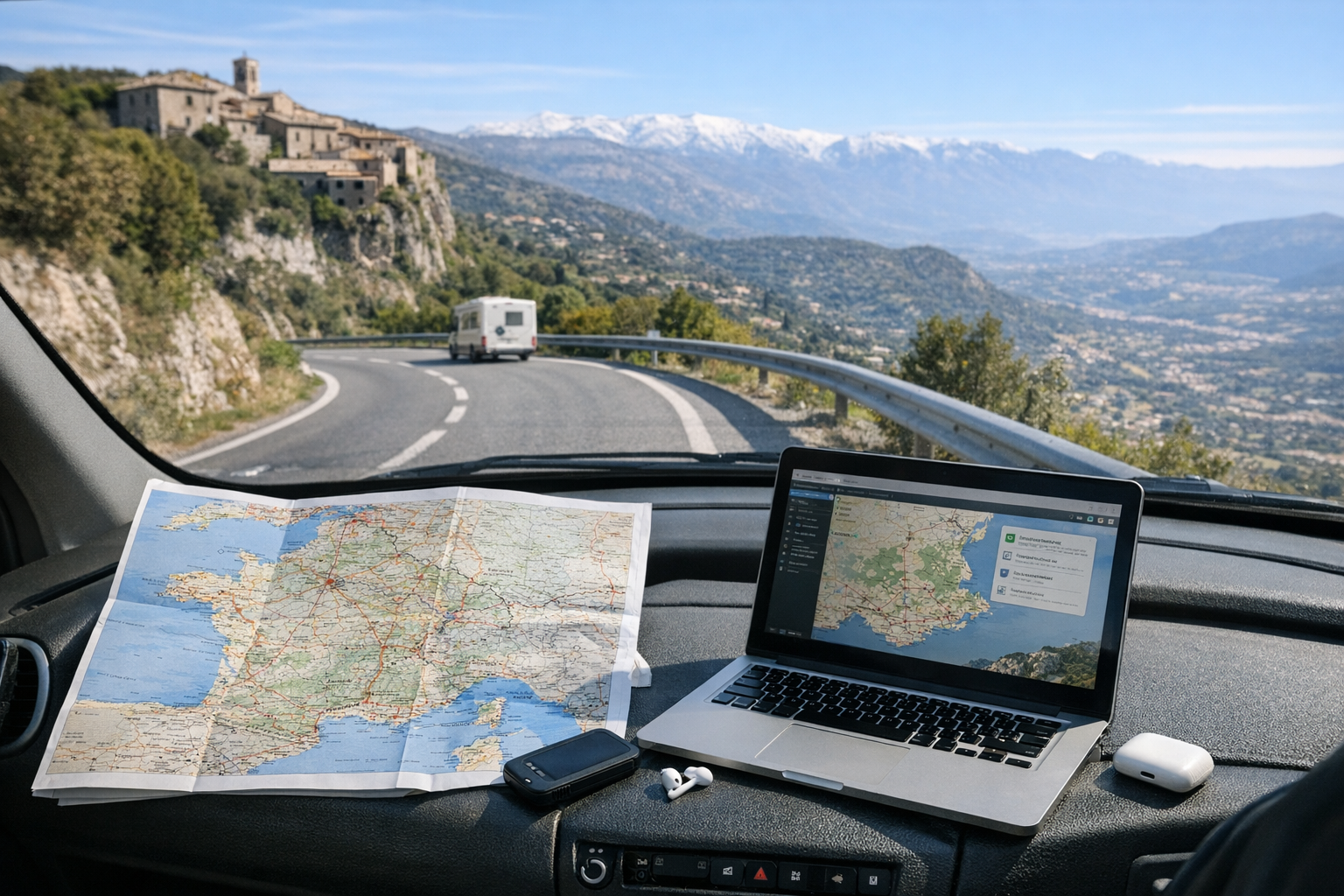
France road‑trip eSIM guide: Best eSIMs for Paris → Nice → Provence (hotspot, coverage, activation)
Quick, practical guidance for picking and activating an eSIM for a 7–14 day Paris→Nice road trip. Focus: hotspot for multiple devices, city & rural coverage, Alpine detours, and activation/APN tips.
Open guide