
France road‑trip eSIM guide
France road‑trip eSIM guide: Best eSIMs for Paris → Nice → Provence (hotspot, coverage, activation)
Best eSIMs and local SIM tips for Paris → Lyon → Avignon → Marseille → Nice. Hotspot rules, rural coverage and step‑by‑step activation for iPhone & Android.
Quick decision: If you need maximum rural coverage and reliable hotspot for family streaming, pick a native MNO eSIM (Orange or SFR). For instant pre‑arrival activation and simple short trips, choose a reputable global eSIM (Airalo/Nomad/Holafly/GoSimo).
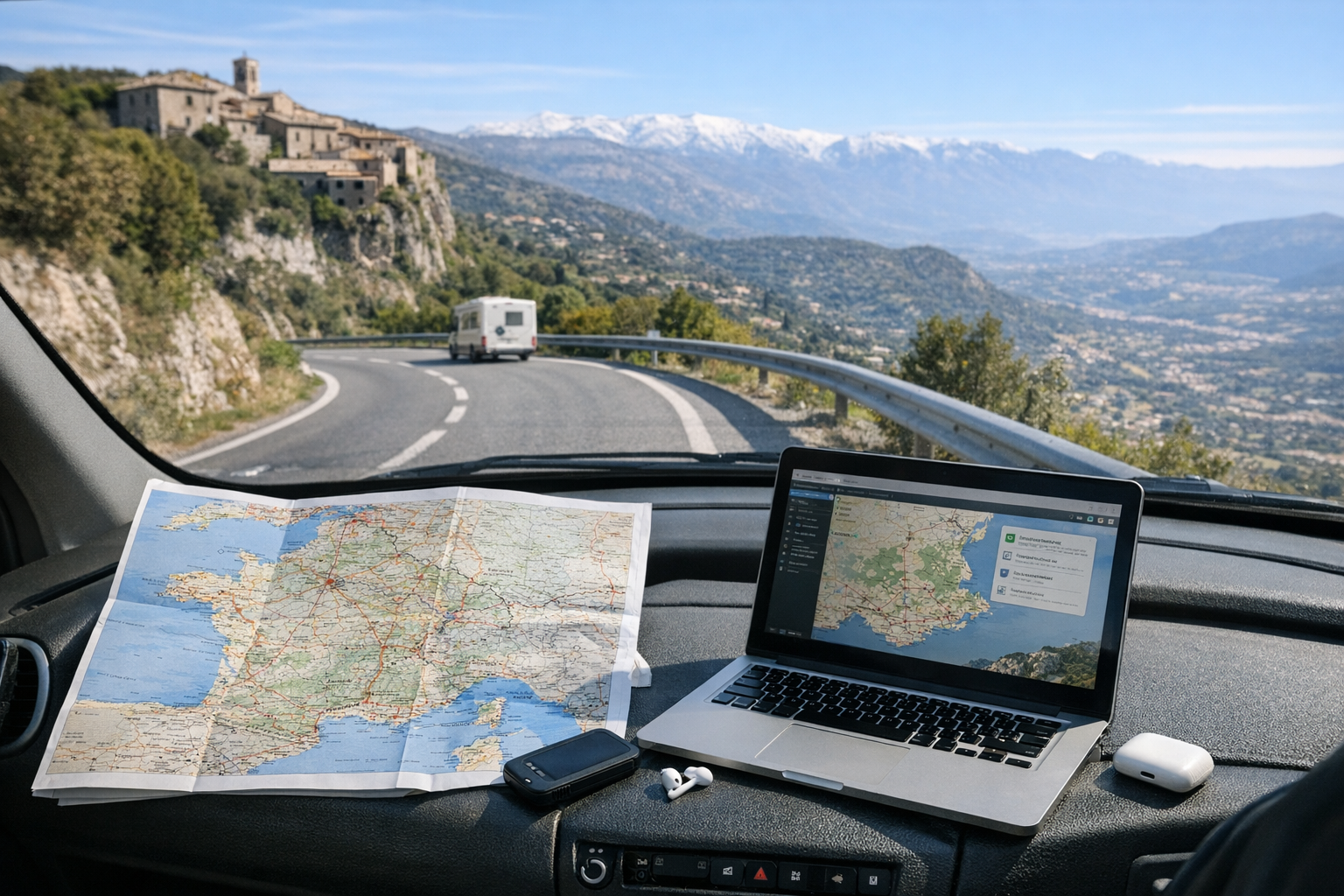
Performance
Real‑world performance callouts
Orange consistently reports the broadest rural coverage; expect more reliable connectivity on Provence backroads and mountain detours compared with other networks.
Free Mobile's plans and 5G are competitive in cities (Paris, Nice), but rural and roaming priority sometimes trails MNOs — test before relying on it for remote work.
SFR and Bouygues give solid urban speeds along the Riviera and in Marseille; both are viable for streaming and train use on TGV corridors.
For families, buy one larger data plan with explicit hotspot allowance or add a multi‑device add‑on; check simultaneous connection limits and carrier NAT behavior.
Buy or wait?
Who should buy a global eSIM vs a local MNO in France
Global eSIMs (Airalo, Nomad, Holafly, GoSimo) are convenient for instant activation before arrival and good for short trips or city‑only itineraries. They usually cover France and neighbouring EU travel.
Native MNO eSIMs (Orange, SFR, Bouygues, Free) give better rural coverage and clearer hotspot/tethering allowances — a safer choice for multi‑day drives through Provence or Alpine detours.
MVNOs (Lebara, Lycamobile) are cost‑effective for light use but can restrict hotspot or deprioritise traffic on congested cells; use them only if you accept possible speed limits and support tradeoffs.
When to pick Orange or SFR
Choose an MNO if you need stable coverage outside cities or plan heavy tethering for multiple devices.
When a global eSIM makes sense
If you land with minimal planning and need quick activation for 7–10 days in cities, buy a global eSIM before travel.
Coverage hotspots
Coverage notes: Paris, Lyon, Marseille, Nice, Provence & Alps
Paris, Lyon, Marseille and Nice all have robust 4G and growing 5G coverage across operators. TGV routes between Paris and Lyon are well covered, though train handovers can cause short drops.
In Provence (Avignon, rural roads between towns, cassis coast) and coastal Riviera routes expect mostly 4G with occasional patchy spots. Orange typically shows the best continuity in operator maps and field reports.
High‑altitude detours (Chamonix, Grenoble approaches) can have spotty coverage; don't assume consistent 5G — plan for offline maps and intermittent uploads.
TGV & stations
Stations usually have good signal, but on‑route connectivity can drop during tunnels and handovers; save offline options for maps and tickets.
Alps & mountain passes
Expect gaps; keep a local MNO SIM or cached directions when hiking or using remote roads.
Hotspot rules
Hotspot & tethering: practical checklist
Most full‑service eSIMs from Orange, SFR, Bouygues and Free permit tethering. MVNOs and some promotional data plans may restrict hotspot or throttle speeds after small caps — always check the plan's terms before purchase.
For family trips, prefer a single large data plan or a plan explicitly stating multi‑device hotspot allowance. Verify simultaneous device limits and carrier NAT/IPv4 behaviour if you need VPN, gaming servers or incoming connections.
If tethering fails after eSIM activation, check APN settings, reboot the device, and toggle airplane mode. For Android you may need to set the mobile hotspot APN manually in some MVNO cases.
Simple hotspot rule
If a plan is sold as 'full MNO data' it's usually fine for tethering; watch for mentions of 'data‑only' or 'no tethering' on MVNO offers.
Simultaneous devices
Car hotspots with multiple tablets/phones can hit throughput limits; prefer plans with larger allowances and no per‑connection caps.
Activation
Step‑by‑step activation & APN troubleshooting (iPhone & Android)
Pre‑arrival eSIM: buy from a provider, scan the QR or install via provider app, and activate while on Wi‑Fi before you land. Some vendors provide automatic provisioning for supported devices.
iPhone: Settings > Cellular > Add eSIM (or use the provider QR). Keep your primary SIM active if you rely on SMS for two‑factor authentication. For data priority, set the eSIM as your preferred data line.
Android: Varies by manufacturer — use Settings > Network & internet > Mobile network > Add carrier, then scan QR. If activation fails, toggle airplane mode, restart, and check manual APN entries.
Common APN examples
Check carrier docs, but commonly seen APNs include Orange ('orange' or 'orange.fr'), SFR ('sfr'), Bouygues ('ebouygues' or provider docs) and Free ('free'). Confirm before manual entry.
If tethering won't start
Confirm the eSIM plan allows hotspot, verify APN, reboot phone, and test with one device. Contact provider support if problems persist.
Plan picks
Recommended plan types for common travellers
Short city trip (7–10 days): global eSIM with 5–15 GB is convenient for Paris‑only or mostly urban itineraries.
Family road trip (7–14 days): choose an MNO eSIM with 30–100 GB or an unlimited tethering add‑on; prioritise Orange or SFR for rural continuity.
Remote worker staying in Nice (2+ weeks): pick a 30–60 day MNO plan with clear hotspot rules, or buy a month MNO eSIM locally to ensure stable uploads for video calls and VPN.
Short stay example
Airalo/Nomad — instant activation, suitable for city sightseeing and light streaming.
Remote work example
Orange/SFR native eSIM — better rural stability and clearer hotspot allowances for sustained uploads.
Comparison
Quick MNO vs global eSIM comparison
| Native French MNOs (Orange, SFR, Bouygues, Free) | Global eSIMs (Airalo, Nomad, Holafly, GoSimo) | |
|---|---|---|
| Coverage & signal | Generally best rural and Alpine coverage; Orange leads in field reports. | |
| Activation | Immediate for eSIMs bought in operator apps or stores; may require ID for long‑term contracts | Pre‑activated instantly before travel; easy QR or app install |
| Hotspot & tethering | Usually allowed and explicitly documented for main plans; clear policy and higher priority | Usually allowed but depends on vendor and wholesale partner; check hotspot wording |
| Support & refunds | Operator stores and phone support in France; in‑store SIM option if eSIM fails | Online chat/email support; refund windows vary by vendor and plan |
Pro tips
Practical tips for a smooth France trip
Buy a global eSIM before arrival if you want immediate connectivity at the airport; switch to a native MNO eSIM if you’ll spend many days outside big cities.
For family hotspots, prefer a single large MNO data plan or an explicit multi‑device add‑on; check simultaneous device limits and carrier NAT if you use VPN/gaming.
Carry a backup: a cheap MVNO SIM (Lebara or Lycamobile) can be a low‑cost emergency data source, but test hotspot before relying on it.
Cache maps and important tickets for tunnels and known rural gaps, especially on Alpine detours (Chamonix, Grenoble).
If SMS verification is needed, keep one line active for incoming SMS or use a temporary local number from an MNO; many data‑only eSIMs block SMS.
Live picks
Top recommended plan types for this itinerary
Saily
France 1GB 7 days
Hidden caveat: French local numbers. Included with most prepaid and postpaid SIMs and eSIMs; in‑store registration may require ID.
Saily
France 3GB 30 days
Hidden caveat: French local numbers. Included with most prepaid and postpaid SIMs and eSIMs; in‑store registration may require ID.
Saily
France 5GB 30 days
Hidden caveat: French local numbers. Included with most prepaid and postpaid SIMs and eSIMs; in‑store registration may require ID.
Saily
France 10GB 30 days
Hidden caveat: French local numbers. Included with most prepaid and postpaid SIMs and eSIMs; in‑store registration may require ID.
Saily
France 20GB 30 days
Hidden caveat: French local numbers. Included with most prepaid and postpaid SIMs and eSIMs; in‑store registration may require ID.
Explore more
Compare live France eSIM plans
Search live plans from global eSIM sellers and French MNOs. Look first for hotspot allowance, plan validity matching your trip length, and operator coverage maps for Provence and the Alps.
Related guides
More France reading

Best eSIMs for France (Paris, Provence, Riviera, Lyon): Coverage, Hotspot & Tethering Guide
Practical guide to picking an eSIM for France — network choices, tethering policies, rural and mountain coverage, and the best buys by itinerary.
Open guide
Best eSIM for France: Paris, Nice & TGV Travel — Complete Guide
A practical guide to choosing an eSIM for France—coverage tradeoffs (Orange vs Free), tethering rules, TGV behavior and activation steps for iPhone/Android.
Open guide